

Overview
Rootly’s Outlook integration lets you schedule calendar events directly from incident workflows. The most common use case is automatically booking a retrospective meeting when an incident resolves, with attendees, description, and timing all populated from incident data.Automated Scheduling
Trigger calendar event creation at any workflow step — on incident creation, escalation, or resolution.
Liquid Templating
Populate event titles, descriptions, and attendees dynamically using incident variables.
Smart Date Scheduling
Schedule events a set number of days out, with optional weekend exclusion, so meetings always land on business days.
Teams Meeting Link
Optionally attach a Microsoft Teams meeting link to the calendar event so attendees can join online.
Before You Begin
- You must be a Rootly admin to set up the integration
- You do not need to be an admin of your company’s Microsoft account
OAuth Permissions
When connecting, Rootly requests the following Microsoft permissions:Installation
1
Open the Outlook integration in Rootly
Go to Settings → Integrations, find Outlook, and click Setup.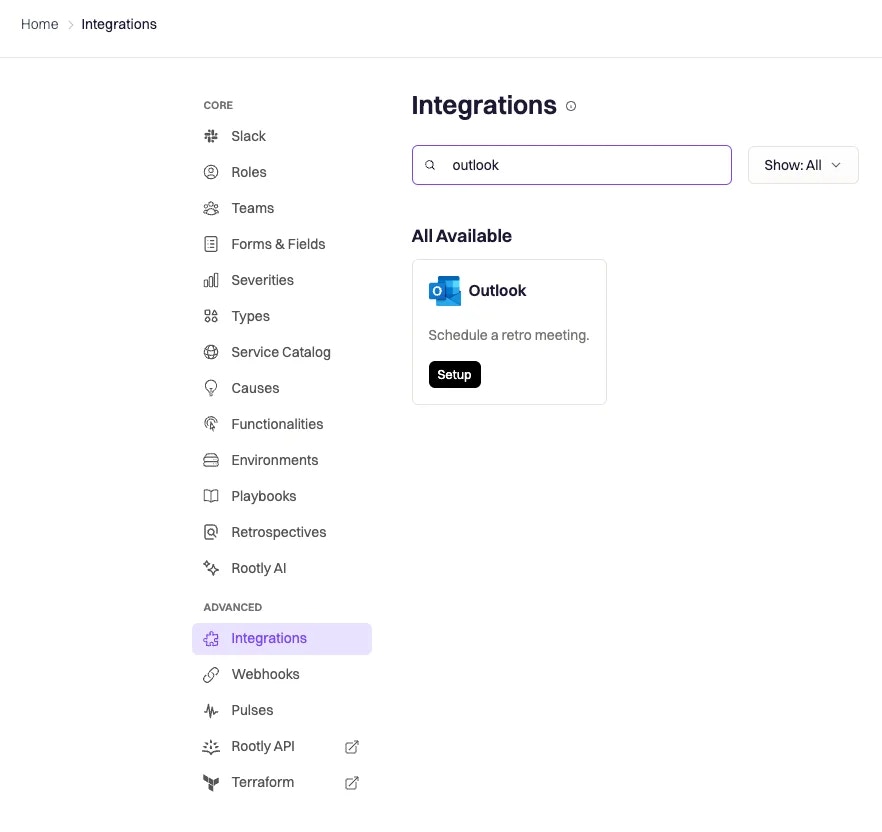
2
Authorize with Microsoft
You’ll be redirected to Microsoft to sign in. Review the permissions Rootly is requesting and click Accept.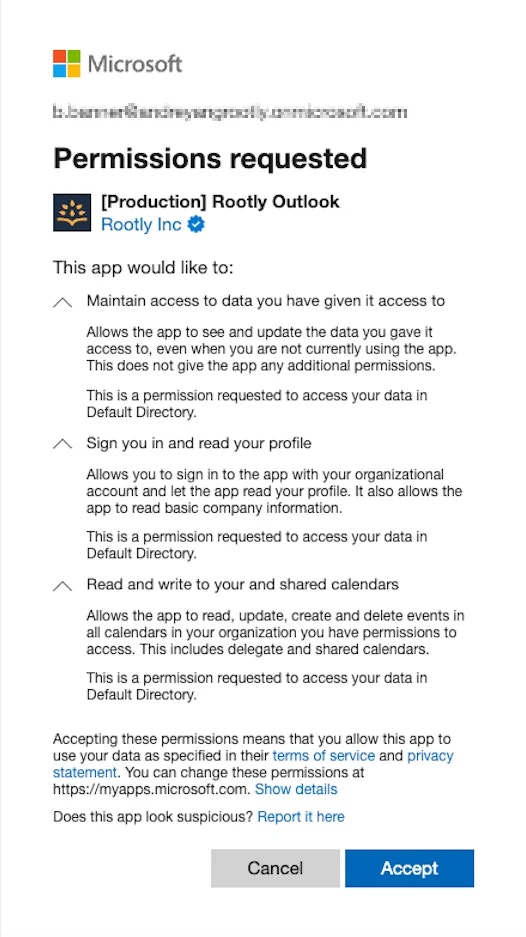
Workflow Action
Create an Outlook Event
Schedules a calendar event on the connected Outlook account. Commonly used to book a retrospective after incident resolution.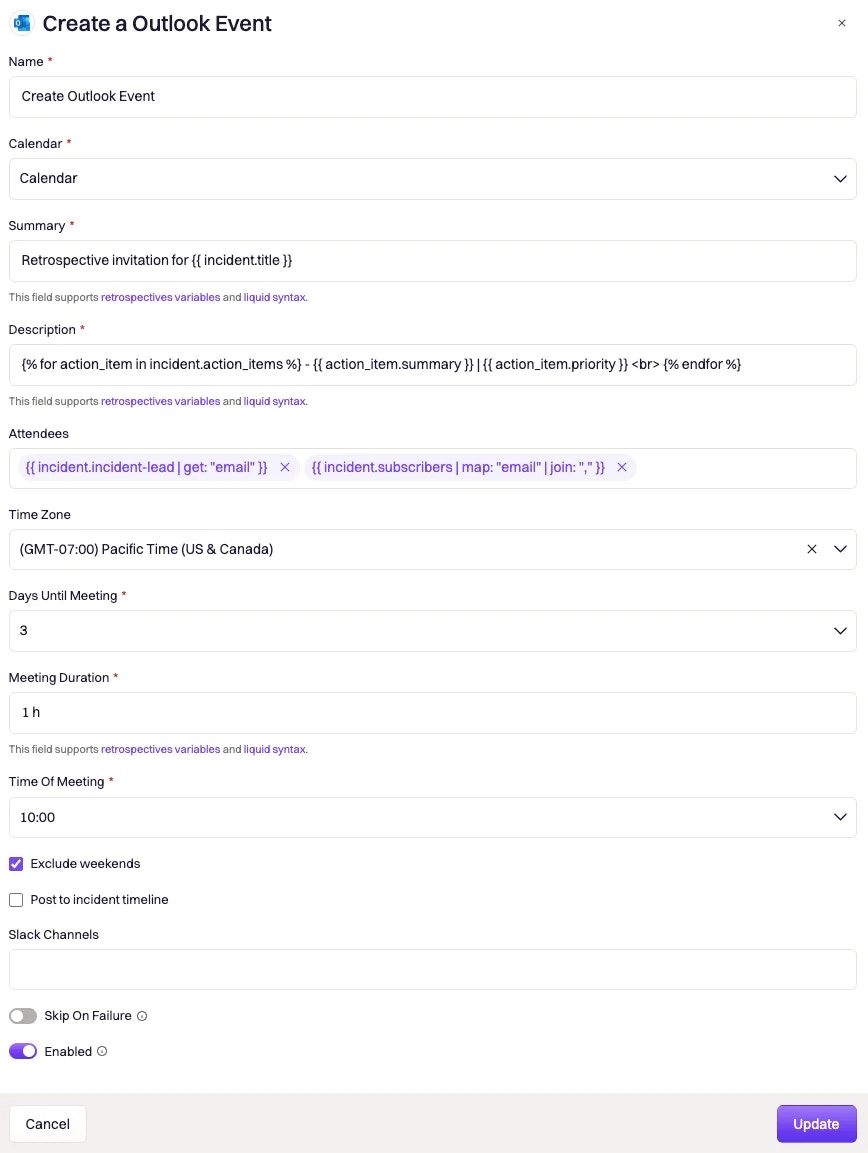
select
required
The Outlook calendar to create the event on. Rootly fetches the list of available calendars from your connected account.
string
required
The event title. Supports Liquid variables — for example,
Retrospective for {{ incident.title }}. Maximum 200 characters.string
required
The event body. Supports Liquid and Markdown. Maximum 200 characters.
array
Email addresses to invite. Supports Liquid — for example,
{{ incident.incident_lead | get: "email" }} or {{ incident.subscribers | map: "email" | join: "," }}.select
The timezone for the event’s start and end times. The Time of Meeting value will be interpreted in this timezone.
integer
required
How many days from the workflow run to schedule the event. Range: 0–31. A value of
0 schedules the event for today.string
required
The length of the event. Minimum 15 minutes. Accepts natural language — for example,
30min, 1h, 1h 30min.string
required
The start time in
HH:MM format (24-hour). Interpreted in the timezone selected above. Defaults to 12:00.boolean
When enabled, weekend days are not counted when calculating the event date from Days Until Meeting. Defaults to
true.boolean
When enabled, attaches a Microsoft Teams meeting link to the calendar event.
boolean
Logs the created event to the incident timeline.
array
One or more Slack channels to share the event details to.
Uninstall
To remove the Outlook integration:- Go to Settings → Integrations and find Outlook
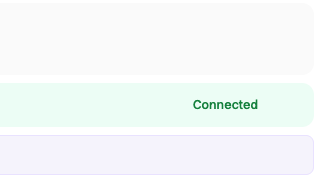
- Click Connected to reveal the disconnect option
- Click Disconnect
Frequently Asked Questions
What happens if Days Until Meeting lands on a weekend?
What happens if Days Until Meeting lands on a weekend?
If Exclude Weekends is enabled, Rootly skips Saturday and Sunday when counting days, so the event will always land on a weekday. If disabled, the event will be scheduled on the weekend day.
Can I create multiple Outlook events for one incident?
Can I create multiple Outlook events for one incident?
Yes. There is no one-per-incident restriction. Each Create an Outlook Event workflow action creates a new calendar event independently.
What happens if the OAuth token expires?
What happens if the OAuth token expires?
Rootly automatically refreshes the token in the background using the stored refresh token. If refresh fails — for example, if the connected account’s permissions were revoked — event creation will fail until you reconnect. This is why a service account is recommended.